The Emerging eTruck Charging Ecosystem
With the rise of electric trucks, a whole new ecosystem of software is emerging around integrating charging into fleet operations and optimizing for cost — unlocking value by connecting once loosely coupled worlds. In this highly dynamic market, young start-ups meet established players from adjacent domains. No single provider covers the full span of eTruck charging yet, so every operator assembles its own stack. With our landscape, we aim to give an overview of the players building in this space.
Battery-electric trucks are set to take over logistics operations in the coming years. Today their numbers are still small: around 18,600 electric trucks operate on EU roads, roughly 0.3% of the total fleet. But adoption is picking up speed.
In 2025, battery-electric vehicles made up 4.2% of heavy-duty truck sales. That sounds modest, but it’s a 70% jump over 2024. Behind this growth are falling eTruck vehicle prices, a broader offering of new models with longer ranges from multiple OEMs, toll exemptions, and rising fuel prices. Together, these bring the total cost of ownership close to that of diesel trucks, and in some cases below it.
This rapid uptake creates new challenges around truck charging, and with them real opportunities to unlock value through smarter operations. How competitive an eTruck really is depends heavily on the price of the electricity it charges, which makes smart charging infrastructure critical for adoption.
Depot charging stands out here, since it is far cheaper than charging publicly. Capturing this value often means connecting worlds that used to have little to do with each other, like truck dispatch and energy procurement. What has emerged is a young and highly dynamic ecosystem where established players from neighboring domains meet a wave of start-ups. In fact, 26 of the companies featured here were founded in 2023 or later. No single solution covers the full span of eTruck operations yet, so every fleet operator ends up assembling its own tech stack from multiple providers. Whether comprehensive closed systems or networks of specialized, interoperable solutions will win out is an open question. The market has yet to see its first exit, and we expect consolidation as it matures.
With this landscape, we set out to identify all the relevant players that help eTruck operators build and run their charging infrastructure. We take the perspective of a fleet operator that charges both at its own depot and at external stations, group the players by their background, and map them to the applications they address.
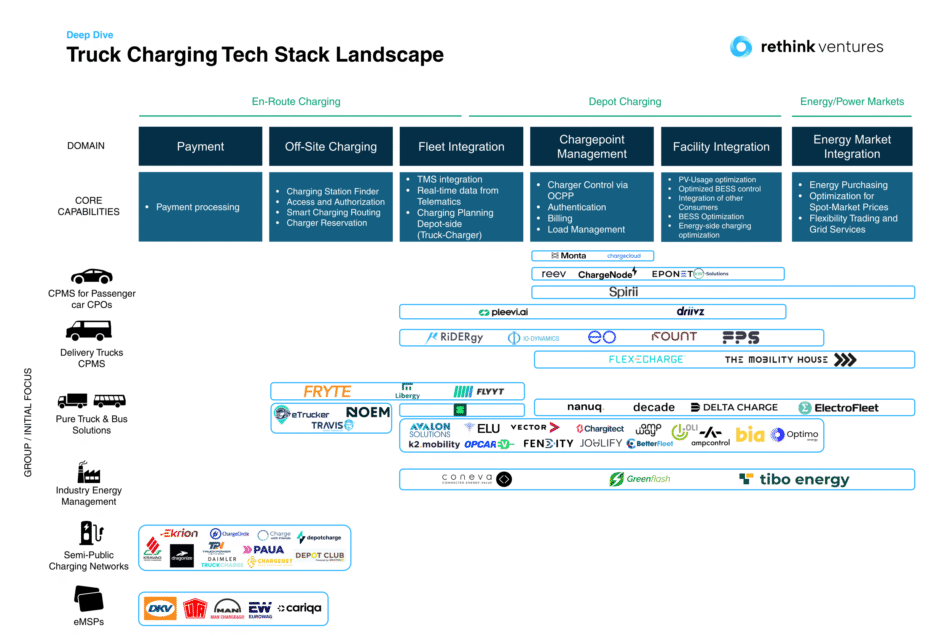
In our deep-dive we identify six domains in which these systems operate:
- Chargepoint Management is the core control layer for depot charging. The Chargepoint Management System (CPMS) operates the depot’s chargers via OCPP, typically handling session authorization, load management (e.g. enforcing site load limits), and billing and payment.
- Fleet Integration extends Chargepoint Management and Off-Site Charging by feeding in real-time fleet data — planned routes from Transport Management Systems (TMS), or vehicle location and state of charge (SoC) from the trucks themselves.
- Off-Site Charging covers charging away from the depot: finding the best charging stops along planned routes, reserving stations, and handling access and authorization.
- Payment manages the financial flows, consolidating charging costs across different Charge Point Operators (CPOs).
- Facility Integration monitors and controls the depot’s energy assets – Photovoltaic systems, battery energy storage systems (BESS), and other loads such as offices and warehouses. It coordinates generation and consumption to support charging and to maximize the use of locally generated energy.
- Energy Market Integration goes a step further, connecting the site more deeply to energy markets to lower costs and provide grid services. At the basic level, this means optimizing against dynamic prices (e.g. day-ahead spot prices); more advanced approaches exploit the flexibility in charging sessions and BESS operation to unlock additional revenue through intraday trading and grid services such as aFRR or redispatch.
Across these domains we have identified a large number of established players and start-ups, and grouped them into six categories by origin – the market each was originally built to serve. We find this lens revealing about each group’s positioning and relative strengths:
- CPMS for CPOs: software built primarily for CPOs serving passenger cars, now extended to truck fleets.
- Delivery Trucks CMS: systems that have managed depot AC charging for delivery fleets for years — predating electric heavy-duty trucks — and already operate large numbers of chargers.
- Pure Truck & Bus Solutions: typically newer entrants, purpose-built from the outset for operating electric heavy-duty fleets.
- Industry Energy Management: systems originally built to manage and optimize energy at industrial sites, since extended to the specific demands of truck charging.
- Semi-Public Charging Networks: systems that give member fleet operators access to charging stations located at private depots.
- eMSPs: systems that handle authentication and payment at public charging stations, e.g. via roaming.
We have deliberately excluded hardware manufacturers, project developers, consultants, and CPOs, focusing on the software side of the ecosystem.
What’s next
We expect this ecosystem to stay dynamic for the foreseeable future. New players will emerge, existing ones will extend their product offering into neighboring applications, and some companies will merge or be acquired. It remains to be seen whether a full-stack provider will eventually emerge or whether fleet operators will continue to work with a set of specialized solutions that need to be connected.
A landscape like this is never complete. If we missed a company, or if you think one is not categorized correctly, please comment on the article or reach out to us directly. We are happy to update it.
See the full list of companies featured in the map:
CPMS for CPOs
- Monta (Denmark, 2020, https://monta.com)
- chargecloud (Germany, 2016, https://www.chargecloud.com)
- reev (Germany, 2018, https://www.reev.com)
- ChargeNode (Sweden, 2015, https://chargenode.eu)
- Eponet (Switzerland, 2020, https://www.ridergy.com)
- kW-Solutions (Austria, 2021, https://www.kw-solutions.at)
- Spirii (Denmark, 2019, https://www.spirii.com)
- pleevi.ai (Belgium, 2024, https://pleevi.ai)
- driivz (Israel / United States, 2012, https://driivz.com)
Delivery Trucks CMS
- Ridergy (Germany, 2022, https://www.ridergy.com)
- IO-Dynamics (Germany, 2018, https://www.iodynamics.de)
- EO (United Kingdom, 2014, https://www.eocharging.com)
- Fount (Norway, 2024, https://fount.energy)
- Flexible Power Systems (United Kingdom, 2017, https://www.flexiblepowersystems.com)
- Flexecharge (Germany / Denmark, 2019, https://www.flexecharge.com)
- The Mobility House (Germany, 2009, https://www.mobilityhouse.com)
Pure Truck & Bus Solutions
- Fryte (Germany, 2025, https://www.fryte.eu)
- Libergy (Germany, 2023, https://libergy.eu)
- FLYYT (Germany, 2025, https://flyyt.app)
- eTrucker (Germany, 2025, https://www.etrucker.io)
- Travis Road Services (Netherlands, 2010, https://www.yourtravis.com)
- NOEM (Germany, year n/a, https://www.noem.live)
- Swytch (Germany, 2025, https://www.swytchfleet.com)
- Avalon Solutions (Germany, 2023, https://www.avalon-solutions.de)
- k2.mobility (Germany, 2023, https://k2mobility.de)
- ELU (ELU Mobility) (Germany, 2023, https://www.elumobility.com/de/)
- OpCar EV (Israel, 2024, https://opcar-ev.com)
- Vector Informatik (vCharM) (Germany, 1988, https://www.vector.com)
- Fenexity (Germany, 2025, https://www.fenexity.com)
- Chargitect (Norway, 2023, https://www.chargitect.com/en/)
- OLI Systems (Germany, 2016, https://www.my-oli.com)
- Joulify (Germany, 2025, https://joulify.de)
- ampway (Germany, 2025, https://ampway.de)
- ampcontrol (United States / Germany, 2019, https://www.ampcontrol.io)
- bia (Spain, 2019, https://www.biapower.io)
- Optimo energy (United Kingdom, 2024, https://optimoenergy.io)
- Decade Energy (France, 2024, https://decade.energy)
- Deltacharge (Germany, 2025, https://www.deltacharge.com)
- Nanuq (Germany, 2023, https://nanuq.tech)
- ElectroFleet (Germany, 2023, https://electrofleet.com)
Industry Energy Management
- coneva (Germany, 2018, https://coneva.com)
- Greenflash (Germany, 2020, https://greenflash.de)
- tibo.energy (Netherlands, 2022, https://tibo.energy)
Semi-Public Charging Networks
- Ekrion (2026, https://ekrion.com)
- Charge Circle (Germany, 2024, https://charge-circle.com)
- Charge with Friends (Austria, 2021, https://www.kw-solutions.at)
- depotcharge (Evolve Energy) (Germany, 2024, https://www.depotcharge.com)
- Kravag Truck Charging (Germany, https://www.kravag-truck-charging.de)
- dragonize (Germany, 2026, https://dragonize.de)
- Truckpower Network (Germany, https://truckpower-network.de)
- Daimler TruckCharge (Germany, https://www.daimlertruck.com)
- Paua / Paua Share (United Kingdom, 2021, https://www.paua.com)
- Chargenet (Netherlands, 2023, https://chargenet.energy)
- Depot Club (by Smatrics, Austria, 2012, https://smatrics.com)
eMSPs
- DKV (Germany, https://www.dkv-mobility.com)
- UTA (Germany, https://web.uta.com)
- Eurowag (Czech Republic, https://www.eurowag.com)
- MAN Charge & Go (Germany, https://www.man.eu)
- cariqa (Germany, 2023, https://www.cariqa.com)